一个视频说清整个英语语法体系(高中总纲版)
本文整理自"英语兔"的语法框架视频,并在原框架上按高中考纲扩充了词法细节、时态语态、三大从句与高考高频易错点,配典型例句与对比表格。建议先通读建立全局,再把它当作查阅手册反复回看——语法框架一旦在脑中成型,剩下的就只是往格子里填细节。
〇、全局地图:一根主线串起所有语法
先给结论:英语语法的核心是动词,整张语法地图都能从动词出发走一遍。
动词
├─ 谓语动词(5 类)──→ 决定五大基本句型
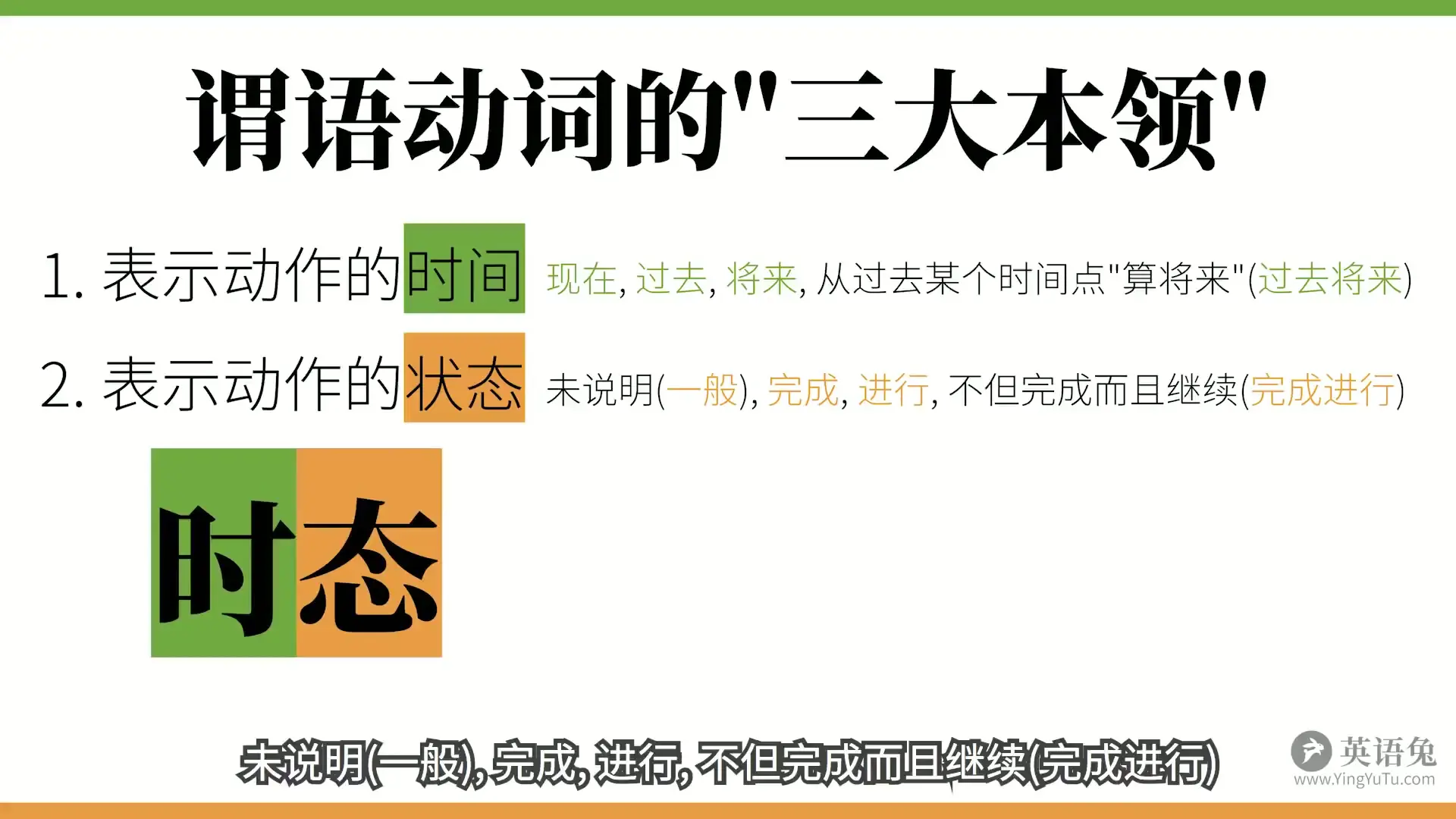
│    ├─ 三大本领:时 · 体 · 气态(TAM)→ 16 种时态 + 语态 + 语气
│    └─ 助动词协助:完成/进行/被动/否定/情态
└─ 非谓语动词(4 形式)──→ 充当除谓语外的一切成分,简化从句

句子成分(8 种)←── 由十大词类充当(唯一例外:谓语只能是动词)

简单句 ──并列──→ 并列复合句
       ──从属──→ 主从复杂句(名词性从句 / 定语从句 / 状语从句)
记住这张图,下面每一节都是在给图上的一个节点填细节。
第一部分:句法骨架 —— 句型与成分
一、学语法的目的:造句
发音带点口音无伤大雅,词汇可以靠阅读积累,但语法错误会出现在你说的每一句话里——这就是为什么语法值得先建立体系。而语法学习的核心目的只有一个:造句。
任何一个英语句子,不断拆解到最后,剩下的都是简单句。除去感叹句、省略句等特殊情况,简单句粗略地说就是两部分:
- 什么(主语 subject)+ 怎么样(谓语 predicate)
易错提醒:中文可以说"今天很热"(无主语),英语必须补上假主语:It is hot today. "主语 + 谓语"的骨架在英语里几乎不可省略。
二、五种基本句型:由动词类型决定
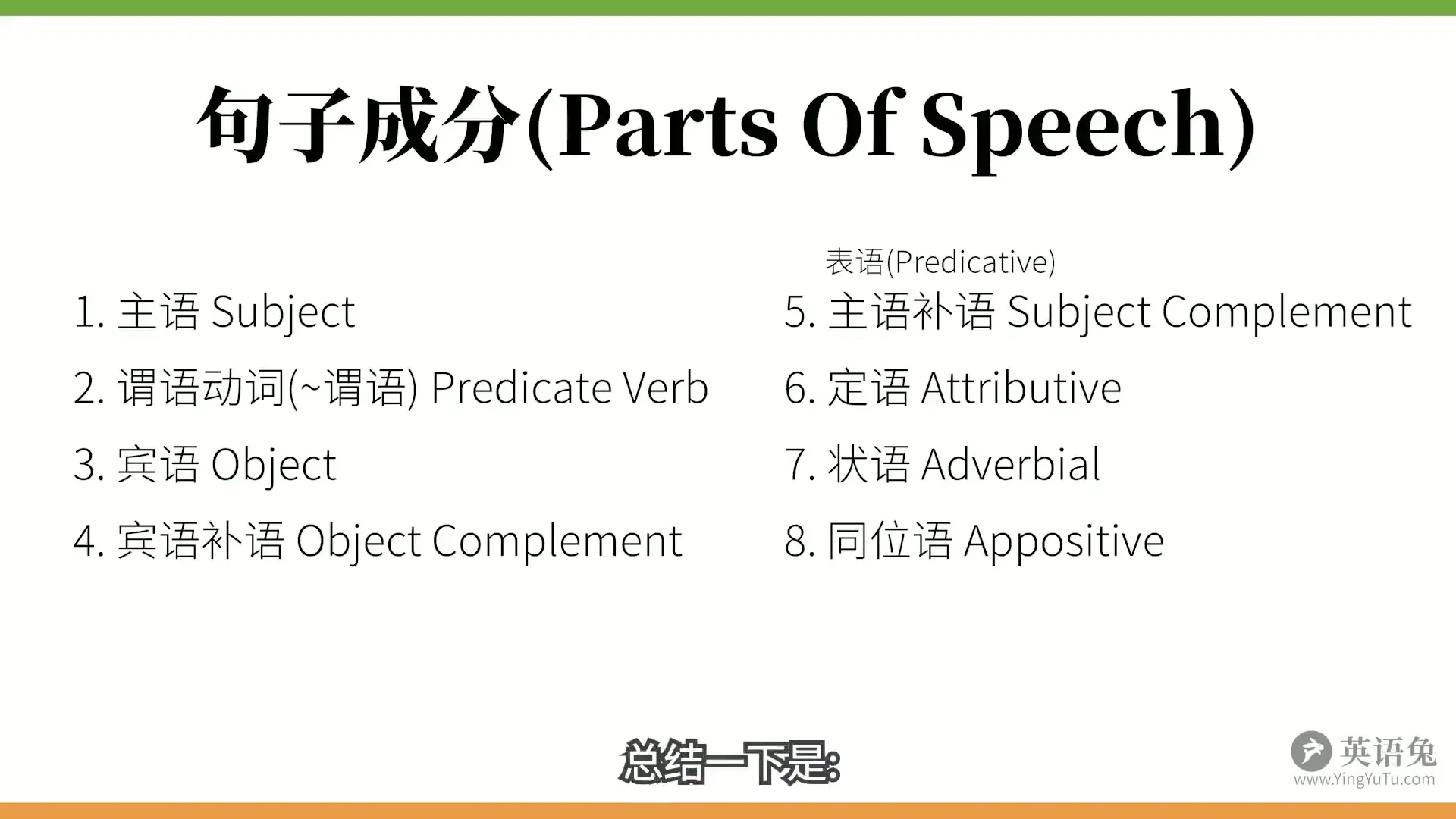
谓语动词分五类,每类决定一种句型。这是整个语法的地基,必须滚瓜烂熟。
| # | 动词类型 | 句型 | 例句 | 判断要点 |
|---|---|---|---|---|
| 1 | 不及物动词 vi | 主 + 谓 | Papa Rabbit sleeps. | 动作无承受者,后面不接宾语 |
| 2 | 单及物动词 vt | 主 + 谓 + 宾 | Papa Rabbit likes you. | 只说 likes 意思不完整 |
| 3 | 双及物动词 | 主 + 谓 + 间宾 + 直宾 | Papa Rabbit teaches you English. | you 是接受者(人间),English 是内容(物间) |
| 4 | 复杂及物动词 | 主 + 谓 + 宾 + 宾补 | Papa Rabbit considers you smart. | 只说 considers you 话没说完,smart 补充宾语 |
| 5 | 系动词 | 主 + 系 + 表 | Papa Rabbit looks tall. | 系动词在主语和表语之间"划等号" |
五大句型口诀:主谓 / 主谓宾 / 主谓间宾直宾 / 主谓宾宾补 / 主系表。
⚠️ 高考易错点 1:同一动词可属多类,意思随之改变。look(不及物:看)→ look after(及物:照顾);smell nice(系动词:闻起来香)≠ smell the flowers(及物:闻花)。判断句型先判断动词当前用法。
⚠️ 高考易错点 2:宾补句型与双宾句型的区分——make him a cake(给他做蛋糕,双宾:a cake = for him)vs make him a star(使他成为明星,宾补:him = a star)。判别法:后一个名词指前一个宾语"是什么"就是宾补。
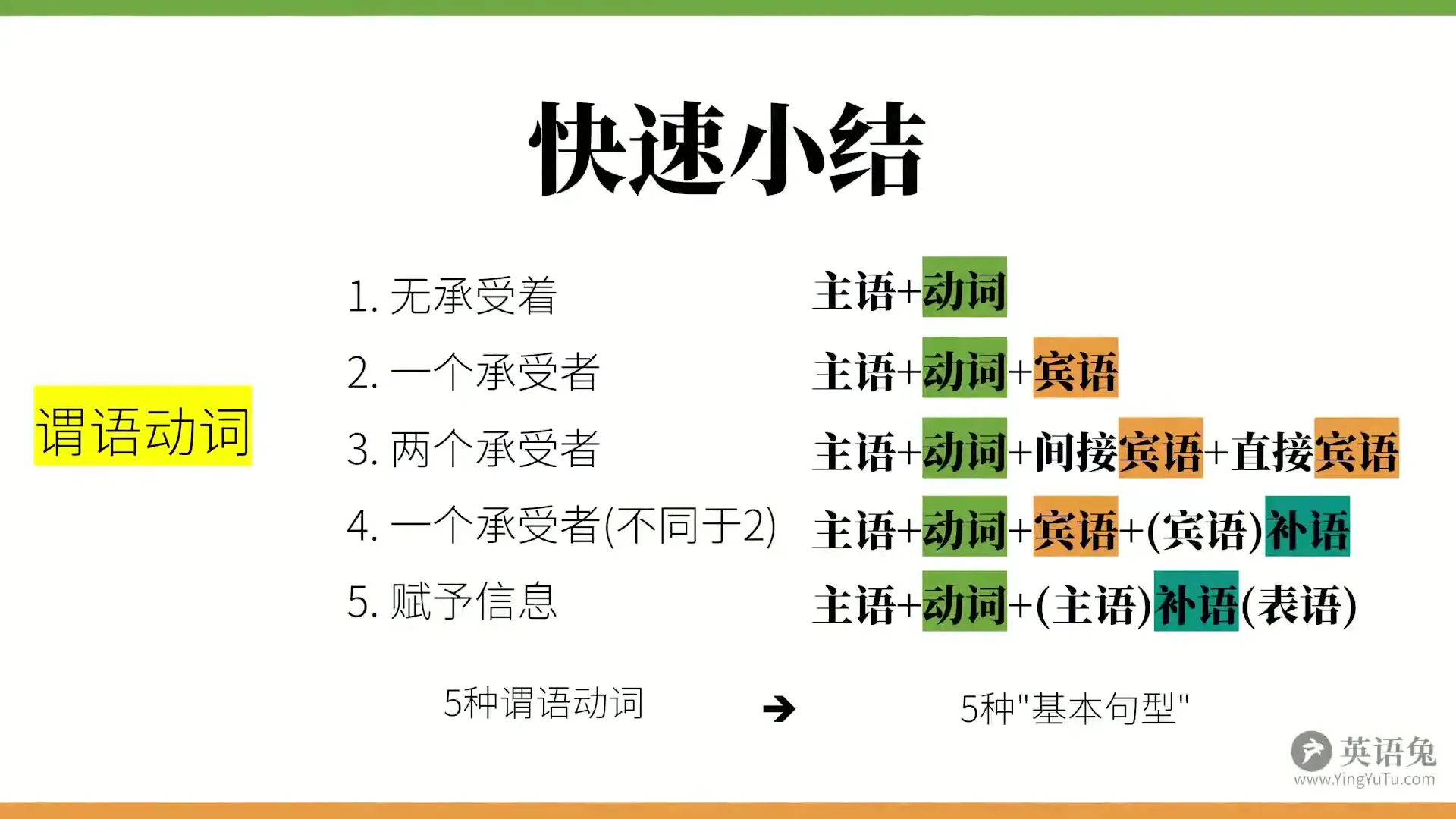
三、句子成分:句子的八个岗位
| 成分 | 作用 | 例句中的位置 |
|---|---|---|
| 主语 subject | 动作发出者/被描述对象 | The little white rabbit ate a large carrot. |
| 谓语动词 | 句子核心动作 | The rabbit ate quickly. |
| 宾语 object | 动作承受者 | The rabbit ate a large carrot. |
| 表语/主补 | 系动词后,赋予主语的属性 | He is a teacher. / It smells nice. |
| 宾补 | 补充说明宾语 | We call him Xiao Wang. |
| 定语 attributive | 修饰名词(主语/宾语) | The little white rabbit / a large carrot |
| 状语 adverbial | 修饰动词/整句 | The rabbit ate quickly. |
| 同位语 appositive | 再说一遍主语/宾语 | Papa Rabbit, an English teacher, eats a carrot. |
关键区分:句子成分 ≠ 词类。 成分是"岗位",词类是"人的性格"——同一个岗位可以由不同性格的人担任:
- 主语可以是名词(Rabbits sleep)、代词(He sleeps)、甚至从句(What he said is true);
- 唯一例外:谓语动词岗位只能由动词担任。
- 十大词类:名词、动词、形容词、副词、代词、数词、冠词、介词、连词、叹词。
易错提醒:定语修饰名词,状语修饰动词/形容词/整句。He is a very good student(very good 是定语)vs He studies very hard(very hard 是状语)。判断方法:问它修饰谁,而不是问它是什么词。
四、从句:简单句的"套娃"组合
简单句组合只有两种方式:
- 并列(compound):I like tea, and he likes coffee. ——地位平等,直接叠加
- 从属(complex):一个简单句"降级"后,充当另一句的成分 → 从句
从句的本质:把一个简单句改造后塞进另一个句子的某个成分位置里。充当什么成分,就叫什么从句:
| 从句充当的成分 | 从句类型 | 例句 |
|---|---|---|
| 主语 | 主语从句 | What he said is true. |
| 宾语 | 宾语从句 | I know that he is honest. |
| 表语 | 表语从句 | The problem is that we lack time. |
| 同位语 | 同位语从句 | The news that he won excited us. |
| (以上四种统称名词性从句) | ||
| 定语 | 定语从句 | The rabbit that ate the carrot is fat. |
| 状语 | 状语从句 | When he came, I was sleeping. |
易错提醒:同位语从句与定语从句都接在名词后,区分方法——同位语从句解释名词的内容(news = that he won),that 不做成分可省略与否看完整性;定语从句修饰限定名词,that/which 在从句里必须充当主语或宾语等成分。
第二部分:词法细节 —— 十大词类的核心规则
五、名词:可数与不可数是第一道分水岭
核心规则:可数名词有单复数,不可数名词没有复数、不能直接加冠词 a/an。
| 类别 | 规则 | 例句 |
|---|---|---|
| 规则复数 | +s / +es(s, x, ch, sh 结尾) | book→books; box→boxes |
| -o 结尾 | 有生命 +es,无生命 +s | tomato→tomatoes; photo→photos |
| f/fe 结尾 | 多数变 ves | leaf→leaves; knife→knives(roof→roofs 例外) |
| 不规则 | 记忆 | child→children; mouse→mice |
| 单复同形 | 集体名词/物种 | sheep, deer, fish |
不可数名词的数量表达:a piece of advice / two cups of tea。常见不可数:information, furniture, advice, news, progress(高考最爱考:informations / furnitures 都是错的)。
所有格:有生命 +'s(Tom's book);无生命用 of(the leg of the table);两者并列各自加 's(Tom's and Mary's books = 各有的书;Tom and Mary's book = 共有的书)。
六、代词:指代清晰是底线
| 代词类型 | 核心规则 | 易错例 |
|---|---|---|
| 人称代词 | 主格作主语,宾格作宾语 | He likes me.(不是 Him likes I) |
| 形容词性物主代词 | 后必接名词 | my book, their house |
| 名词性物主代词 | 独立使用 | This book is mine. |
| 反身代词 | 与主语呼应或强调 | He hurt himself.(不能说 hurt him——那表示伤了别人) |
| 指示代词 | this/these 近,that/those 远 | — |
| 不定代词 | 修饰语后置 | something important(不是 important something) |
高考高频:everyone/someone 等复合不定代词永远接单数动词(Everyone is here),但反义附加问句用 they(Everyone is here, aren't they?);none of + 复数名词动词可单可复。
七、冠词:a / an / the 的三分天下
| 冠词 | 用法 | 例句 | 口诀 |
|---|---|---|---|
| a/an | 泛指一个(可数单数) | A rabbit is eating. | 第一次提到用 a/an;an 用于元音音素前 |
| the | 特指(双方都知道/第二次提到/独一无二) | The rabbit on the sofa is fat. | 特指、上文提过、世界上唯一(the sun) |
| 零冠词 | 泛指复数、不可数、专有、抽象概念 | Rabbits are cute. / by bus / in hospital | 泛指类别、日常短语固定搭配 |
易错提醒: - an 看的是发音不是字母:an hour(h 不发音),a university(/juː/ 辅音起头)。 - 乐器前加 the:play the piano;球类前不加:play basketball。 - in hospital 住院(泛指)vs in the hospital 在医院里(特指建筑);go to school 上学 vs go to the school 去学校(办事)——"the 加不加,含义常不同"是高考单选的经典考点。
八、形容词与副词:位置、顺序与比较级
位置与顺序:多个形容词排序口诀 "限观形龄色国材"(限定词→观点→形状→年龄→颜色→国籍→材料):a beautiful little red Chinese wooden box。
| 比较结构 | 句式 | 例句 |
|---|---|---|
| 原级 | as + adj + as / not so...as | He is as tall as his brother. |
| 比较级 | adj + er/more + than | She is more careful than me. |
| 最高级 | the + adj + est/most | He is the tallest in our class. |
高考易错点: 1. 比较对象要对等:The weather in Beijing is colder than that in Guangzhou.(必须用 that/those 指代,不能直接 than Guangzhou 的 weather 和城市比) 2. 倍数表达三种句式:twice as...as / twice more than / twice the size of。 3. -ing 与 -ed 形容词:boring(令人无聊,主动)vs bored(感到无聊,被动感受)——interesting/interested, exciting/excited 同理。 4. 副词 too/enough 位置:too tired to walk(too 在前)/ old enough(enough 后置)。
九、介词:固定搭配大于"理解"
介词没有万能公式,核心靠搭配积累,但有三条主线:
- 时间:at 时刻(at 7:00)→ on 具体日(on Monday, on May 1st)→ in 长时段(in May, in 2026, in the morning)
- 地点:at 点 → on 面/线上 → in 空间内部
- 固定短语:depend on, be interested in, be good at, be afraid of, agree with sb / to sth
易错提醒:by + 方式(by bus, by hand)不带冠词;in + 语言/材料(in English, in ink);"在周末" 英式 at the weekend / 美式 on the weekend,考试以教材为准。
十、动词时态与语态:16 种时态的排列组合
10.1 时态 = 时间 × 状态
时态不是 16 个孤立的表格,而是 4 种时间(现在/过去/将来/过去将来)× 4 种状态(一般/进行/完成/完成进行)的排列组合。高中重点掌握 8 种:
| 时态 | 结构 | 例句 | 时间标志词 |
|---|---|---|---|
| 一般现在时 | do/does | Water boils at 100°C. | always, usually, every day |
| 一般过去时 | did | He came yesterday. | yesterday, last week, in 2020 |
| 一般将来时 | will do / be going to | It will rain tomorrow. | tomorrow, next year, soon |
| 现在进行时 | am/is/are doing | She is reading now. | now, at the moment, Look! |
| 过去进行时 | was/were doing | I was sleeping when he called. | at that time, this time yesterday |
| 现在完成时 | have/has done | I have finished my homework. | already, yet, since, for, so far |
| 过去完成时 | had done | The train had left when I arrived. | by the time, by then(过去的过去) |
| 一般过去将来时 | would do | He said he would come. | 宾语从句中随主句过去时 |
高频易错提醒: 1. since + 时间点,for + 时间段:I've lived here for ten years / since 2016。 2. 现在完成时不能与明确过去时间连用:I have seen him ~~yesterday~~(应为 saw him yesterday)。 3. 瞬间动词(come, die, join)完成时不接时间段:He has been dead for two years(不是 has died for...)。 4. 主将从现:时间/条件状语从句中用一般现在时表将来——If it rains tomorrow, we will stay home.(不是 if it will rain) 5. 时间标志词只是参考,语境判断才是王道。
10.2 被动语态:be + 过去分词
被动 = be 的各种时态 + done。只有及物动词有被动。
| 时态 | 被动式 | 例句 |
|---|---|---|
| 一般现在 | am/is/are done | English is spoken here. |
| 一般过去 | was/were done | The bridge was built in 1990. |
| 一般将来 | will be done | The work will be finished soon. |
| 现在完成 | have/has been done | The book has been translated. |
| 含情态动词 | can/must be done | The job must be done at once. |
易错提醒:感官动词/使役动词在主动句中宾补不带 to,被动句必须还原 to——He made me work. → I was made to work.(高考必考)
10.3 语气与虚拟:if 的三种虚拟句
| 类型 | if 从句 | 主句 | 例句 |
|---|---|---|---|
| 与现在相反 | 过去式(be→were) | would/could + do | If I were you, I would accept it. |
| 与过去相反 | had done | would have done | If he had studied, he would have passed. |
| 与将来相反 | should/were to do | would do | If it were to snow, we would cancel the trip. |
易错提醒:混合虚拟(从句过去、主句现在)需按各自时间单独选式;If I had known, I would have told you 中 had known 不能写成 would have known——从句里永远不出现 would。
十一、助动词:谓语动词的"工具箱"
谓语动词表达时态、语态、否定、疑问、情态,都要借助助动词:
- 完成态:have eaten | 进行态:is eating | 被动:is eaten
- 否定:do not eat | 情态:can / might / must / should + 动词原形
一词多身份警告:can 也是"易拉罐",must 也是"必须/发霉"同音,do 也是"做",have 也是"拥有",be 也是"存在"。看到句子先判断它是助动词还是实义动词——否定疑问时,助动词才能提前/加 not:Do you have a pen?(have 是实义)vs Have you finished?(have 是助动词)。
情态动词三条重点: 1. 后接动词原形(除 ought to); 2. 表推测的可能性排序:must > may > might(must have done 对过去的肯定推测:He must have missed the train); 3. need/dare 既是情态又是实义:Need he go?(情态)vs Does he need to go?(实义)。
十二、非谓语动词:动词的"变形金刚"
动词离开谓语岗位去干别的(主语、宾语、定语、状语、补语),就要"变形"。四种形式:
| 形式 | 形态 | 核心用法 | 例句 |
|---|---|---|---|
| 不定式 | to do | 目的/将来;具体动作 | To learn English, he reads every day. / I want to sleep. |
| 动名词 | doing | 作主语/宾语,表抽象习惯 | Swimming is fun. / I enjoy swimming. |
| 现在分词 | doing | 主动/进行;作定语状语 | the sleeping baby(正睡的); Seeing the police, he ran. |
| 过去分词 | done | 被动/完成 | the broken cup(被打破的); Seen from space, the earth is blue. |
分词作状语的黄金判别法:看分词与主句主语的关系——主动/进行用 doing,被动/完成用 done。
- Facing the difficulty, he stayed calm.(he 主动面对)
- Faced with the difficulty, he stayed calm.(he 被困难摆在面前,be faced with 固定搭配)
高频易错提醒: 1. 只接不定式的动词:want, hope, decide, agree, refuse;只接动名词:enjoy, finish, avoid, mind, suggest(suggest doing 不是 suggest to do)。 2. 接 to do 与 doing 意思不同:remember to do(记得要去做,未做)vs remember doing(记得做过,已做);stop to do(停下来去做)vs stop doing(停止做)。 3. 独立主格与悬垂分词:分词的逻辑主语必须是句子主语,否则要用独立主格——Weather permitting, we'll go hiking.(weather 不是句子主语,不能用 permitting 直接挂)
第三部分:句法进阶 —— 三大从句与特殊句式
十三、三大从句精讲(高考的重头戏)
13.1 名词性从句:连接词的选择
四种名词性从句(主语/宾语/表语/同位语)共用一套连接词,选择逻辑:
| 连接词 | 用法 | 例句 |
|---|---|---|
| that | 从句是陈述句;that 无实义不作成分(宾语从句中可省) | I believe that he is right. |
| whether/if | 从句是"是否"疑问 | I wonder whether/if he will come. |
| who/what/which | 连接代词,在从句中作成分 | What he needs is time. |
| when/where/why/how | 连接副词,作状语 | Where we will meet hasn't been decided. |
易错提醒: 1. whether 与 if 的五个区别:介词后、不定式前、主语从句句首、or not 直连,只用 whether(Whether he comes or not doesn't matter)。 2. 名词性从句一律用陈述语序:I don't know where he lives.(不是 where does he live——高考最大失分点之一) 3. 同位语从句常见于抽象名词后:fact, news, idea, hope, belief + that 从句。
13.2 定语从句:关系词的两大职能
关系代词(who/whom/whose/which/that)在从句中充当成分;关系副词(when/where/why)相当于"介词 + which"。
| 情况 | 用法 | 例句 |
|---|---|---|
| 先行词是人 | who / that / whom(宾格) | The man who lives next door is a doctor. |
| 先行词是物 | which / that | The book which/that I bought is great. |
| 所属关系 | whose(人/物皆可) | the boy whose father is a teacher |
| 时间/地点/原因 | when/where/why = 介词+which | the day when we met / the house where I lived |
高考高频考点: 1. 只能用 that 的五种情况:先行词被序数词/最高级修饰、all/everything/nothing 等不定代词、被 the only/the very 修饰、人和动物并存、疑问词 who 开头的主句。 2. 只能用 which 的情况:非限制性定语从句(逗号后,指物)、指代前面整句话(He passed the exam, which surprised us.)。 3. 介词提前时只用 which/whom:the house in which I lived(不能 in that)。 4. 关系副词与关系代词的选择看从句缺什么:缺主语/宾语用 that/which,缺状语用 where/when——This is the place (that) I visited.(visit 缺宾语,用 that)vs This is the place where I stayed.(stay 不及物缺地点状语)。
13.3 状语从句:九类连词一张表
| 类型 | 常用连词 | 例句 |
|---|---|---|
| 时间 | when, while, as, before, after, until, as soon as | Wait until he comes back. |
| 条件 | if, unless, as long as | Unless you hurry, you'll be late. |
| 原因 | because, since, as | Because it rained, we stayed in. |
| 让步 | although/though, even if, however | Although he is rich, he is not happy. |
| 目的 | so that, in order that | Speak louder so that everyone can hear. |
| 结果 | so...that, such...that | He ran so fast that no one caught up. |
| 比较 | than, as...as | She is taller than I (am). |
| 方式 | as, as if/as though | He acts as if he knew everything. |
| 地点 | where, wherever | Where there is a will, there is a way. |
易错提醒: 1. although 不与 but 连用(中文"虽然…但是…"的直译陷阱);同理 because 不与 so 连用。 2. until 的否定:not...until 直到…才(He didn't sleep until midnight);句首 until 从句主句要部分倒装。 3. while 表对比(而)与 when 表时间点、as 表伴随的区别:He sang as he worked.(一边…一边)
十四、倒装与强调:正式语体的两大杠杆
完全倒装(整个谓语提前):表地点方位的副词/介词短语开头——Here comes the bus. / In front of the house stands a tall tree.
部分倒装(只提前助动词)五大触发条件:
| 触发条件 | 例句 |
|---|---|
| 否定词开头(never, seldom, hardly, not until, no sooner) | Never have I seen such a thing. |
| only + 状语开头 | Only then did I realize the truth. |
| so/neither/nor 承前 | He can swim. So can I. / Neither do I. |
| not until 从句开头 | Not until midnight did he sleep. |
| as/though 让步倒装 | Tired as he was, he kept working. |
强调句型:It is/was + 被强调部分 + that/who + 其余部分。检验法:去掉 It be...that 后句子仍完整才是强调句——It was in the park that I met him.(去掉后 I met him in the park 成立 ✓)。
易错提醒:强调句与主语从句外形相似,关键看去掉框架后是否成立;only 修饰主语时不倒装(Only he can help me ✓),only 修饰状语才倒装。
第四部分:总框架与学习路线
十五、把全图拼回来
现在回到开头的地图,你已经能走通每一条线:
- 动词是核心,分谓语与非谓语两大阵营;
- 谓语动词五类 → 五大句型 → 八大句子成分(由十大词类充当);
- 谓语动词的 TAM(时、体、气)+ 助动词工具箱 → 时态、语态、虚拟;
- 非谓语四种形式 → 取代从句、简化句子;
- 简单句 → 并列/从属 → 三大从句 → 倒装强调等特殊句式。
这套框架是粗线条的——它牺牲了细节(英语有大量特例),但换来一张能装下所有细节的地图。遇到新的语法点,先问"它在地图的哪个位置",再往格子里填,记忆效率完全不同。
十六、高中三年怎么用这张地图
| 阶段 | 任务 | 对应本文章节 |
|---|---|---|
| 高一上 | 句型骨架 + 时态打底 | 一、二、三、十 |
| 高一下 | 三大从句全面铺开 | 四、十三 |
| 高二 | 非谓语 + 虚拟 + 倒装(语法的三座山) | 十二、10.3、十四 |
| 高三 | 按表格逐项排雷,错题归位到地图 | 全文查漏 |
三条学习建议:
- 以造句检验学习:每学一条规则,用它造 2 个自己的句子——语法书看得懂不等于会用,输出才算掌握。
- 错题归位:把错题按本文 16 节分类贴标签,三周后你会看到自己的薄弱节点集中在哪几格。
- 容忍例外:框架管 90% 的句子,剩下 10% 的例外靠阅读积累语感——先有地图,再谈例外,顺序不能反。
本文框架源自"英语兔"的语法体系视频,扩充部分结合高中考纲整理。语法特例浩如烟海,本文如有疏漏以教材和高考真题为准;欢迎在评论区指正与讨论。